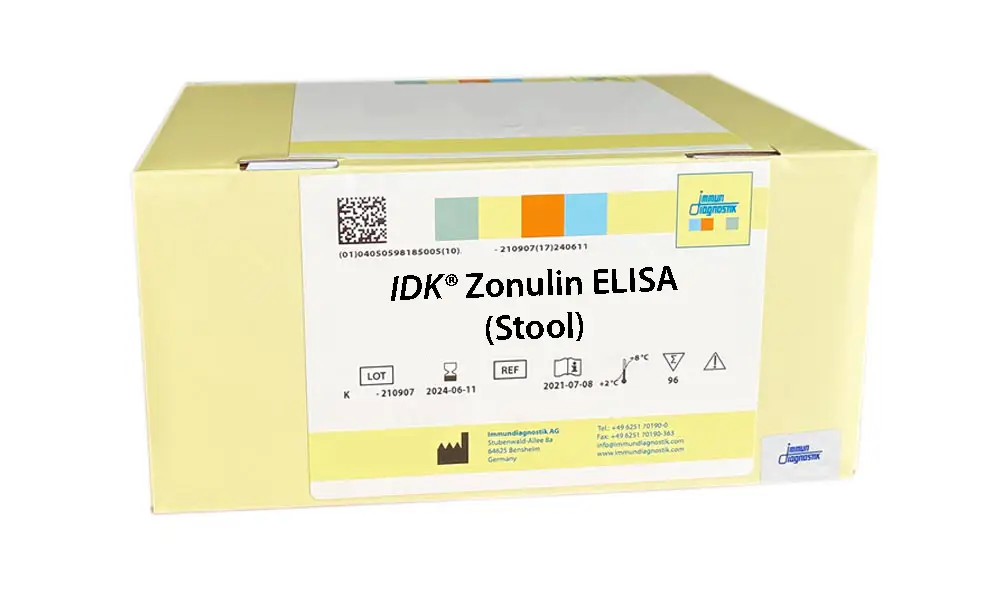
The IDK® Zonulin ELISA (Stool) is intended for the quantitative determination of zonulin in stool to assess intestinal permeability.
Health Canada Licensed.
For Laboratory Professional Use Only.
Not for sale in the U.S. Please contact us to order or get a quote.
If you are in the U.S., we offer an RUO version of this kit: KR5600
Manufactured by Immundiagnostik AG.
Also available:
- Zonulin ELISA (Serum, Health Canada): K5601
- Zonulin ELISA Bulk Pack (Stool, 20 Plates): KR5600.20
- Zonulin ELISA Bulk Pack (Serum, 20 Plates): KR5601.20
- Zonulin ELISA (Serum): KR5601
Test Principle of the IDK® Zonulin ELISA (Stool)
The IDK® Zonulin ELISA (Stool) is based on the method of competitive ELISA.
As a first preparation step, biotinylated zonulin is added to the samples, standards, and controls. Afterward, aliquots of the treated samples, standards, and controls are transferred and incubated in microtiter plate wells coated with polyclonal anti-zonulin antibodies. During the incubation, the free target antigen in the samples competes with the biotinylated zonulin for the binding of the polyclonal anti-zonulin antibodies immobilized on the microtiter plate wells. The unbound components are removed by a washing step.
During a second incubation step, peroxidase-labeled streptavidin, which binds to the biotinylated zonulin, is added to each microtiter well. After a washing step to remove the unbound components, the peroxidase substrate tetramethylbenzidine is added.
Finally, the enzymatic reaction is terminated by an acidic stop solution. The color changes from blue to yellow, and the absorbance is measured in the photometer at 450 nm. The intensity of the yellow color is inversely proportional to the zonulin concentration in the sample; this means a high zonulin concentration in the sample reduces the concentration of the biotinylated zonulin bound to the immobilized anti-zonulin antibodies and lowers the photometric signal.
A dose-response curve of absorbance unit (optical density, OD at 450 nm) vs. concentration is generated using the values obtained from the standard.